Grade 12 · Probability
Grade 12 Probability Worksheets
Printable Grade 12 probability worksheets, sized to fit one page. Download a free sample below, or pick beginner, intermediate, or advanced and generate a fresh pack with answer keys in seconds. No AI, no wrong answers.
Create free worksheets →Free to start · answer keys included · free accounts get 14 days of Standard · no card required.
Grade 12 examples by level
- BeginnerA bag has 2 red and 3 blue marbles. P(red) =Answer2/5 (0.40, 40.0%)
- IntermediatePercent: A bag has 5 red and 6 blue marbles. One is drawn and not replaced. Given the first marble drawn is red, P(the second is also red) =Answer40.00% (2/5, 0.4000)
- AdvancedFraction: A bag has 11 red, 4 blue, and 11 green marbles. P(red) =Answer11/26 (≈0.42, ≈42.3%)
Real problems from the generator: always mathematically correct, and every pack is different.
Download a free Grade 12 probability worksheet
One page, ready to print, no account needed. Pick a level:
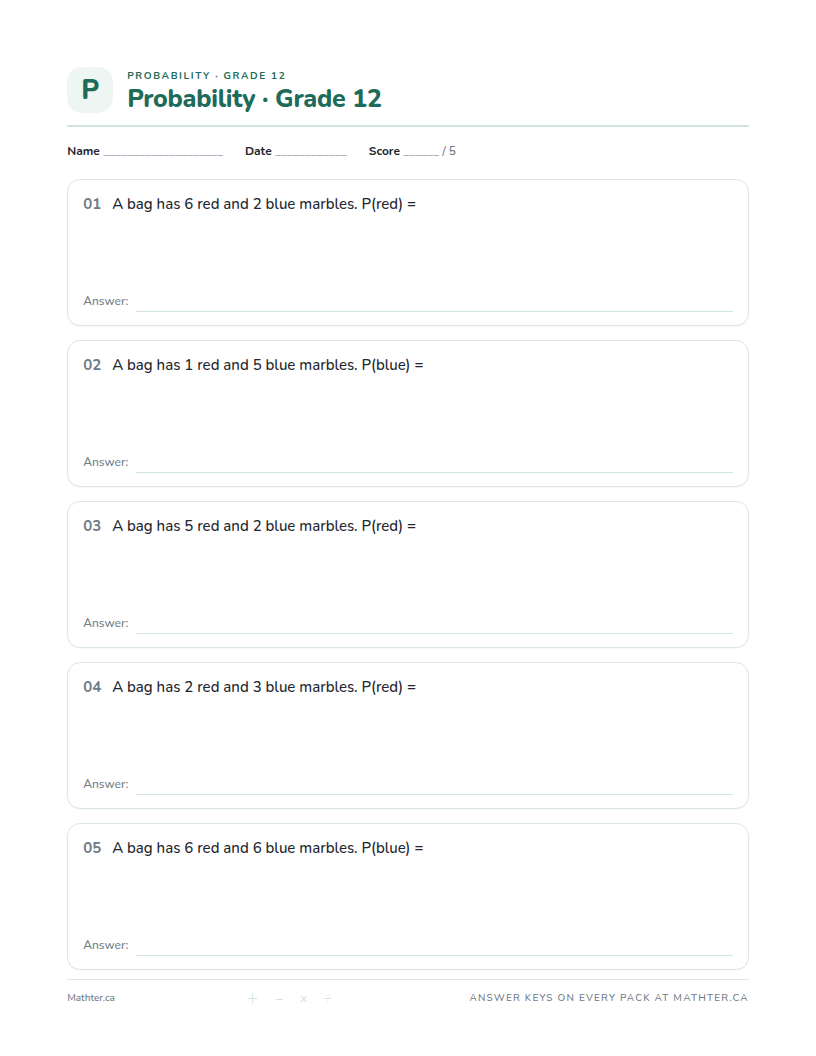
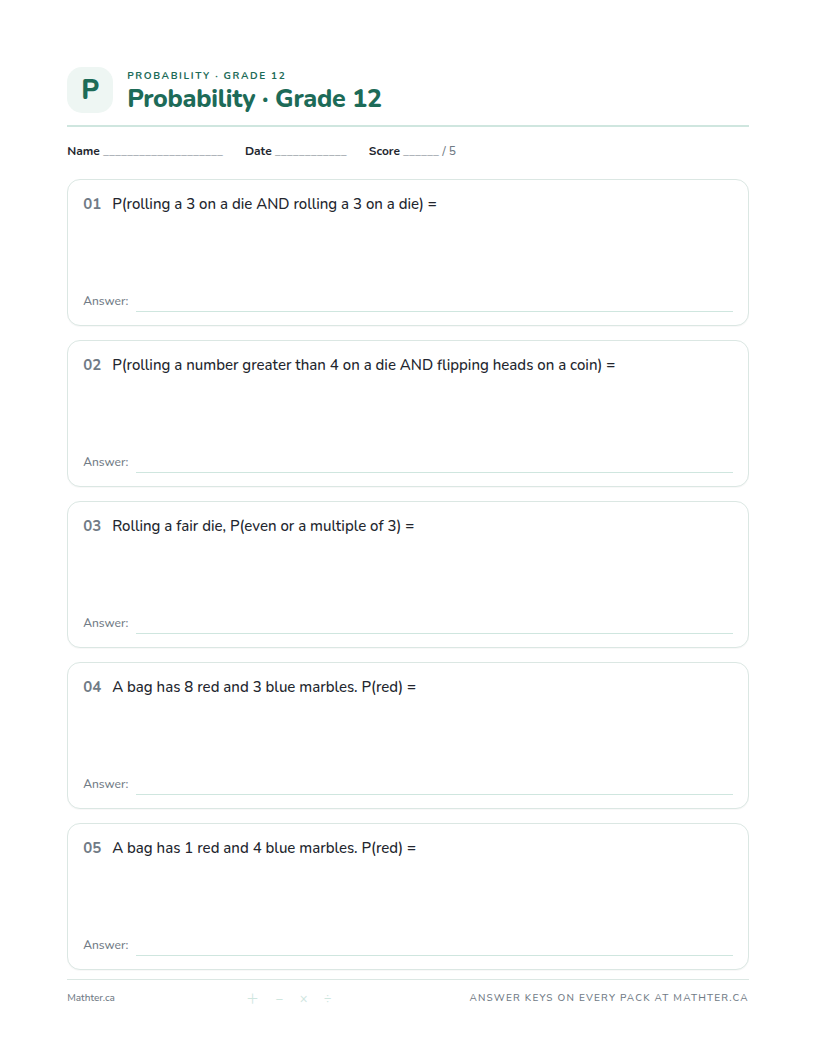
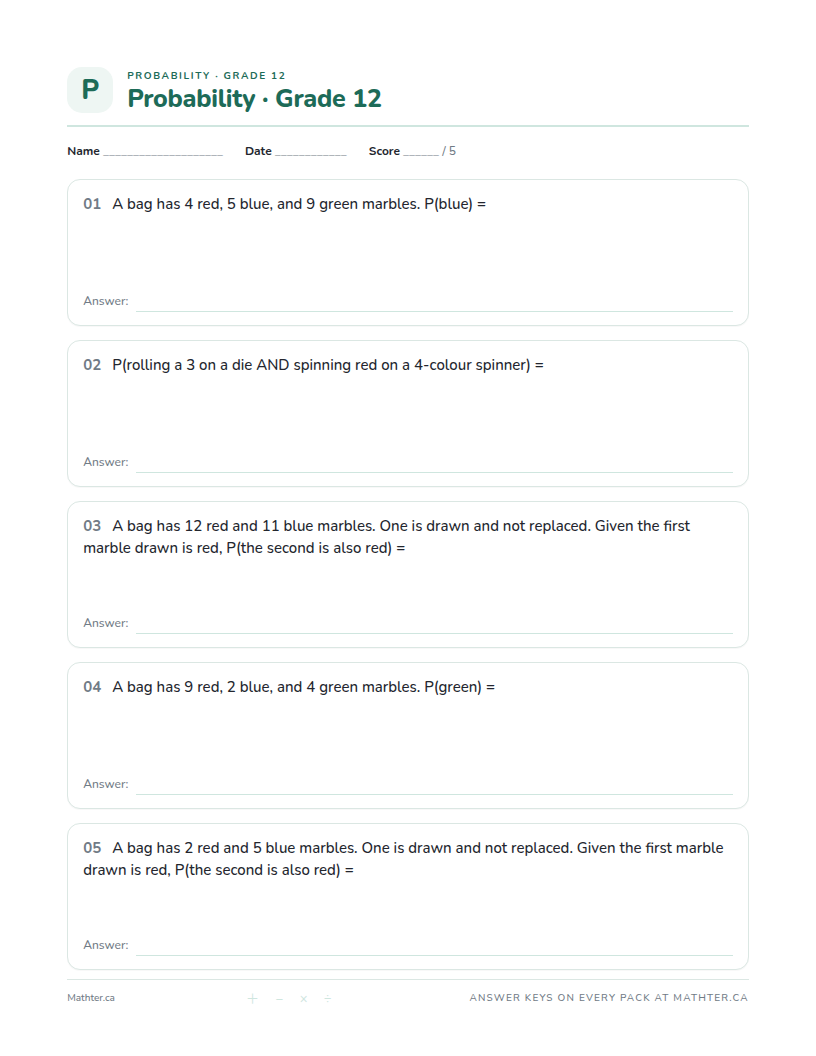
These three sheets are fixed, so you can bookmark or share them and get the same page back. Answer keys and fresh numbers come with a free account.
Why Grade 12 probability practice matters
What fraction of the outcomes actually go your way? That question, turned into a number between 0 and 1, is exactly what a 40 percent chance of rain means.
Grade 12 is the most advanced probability practice Mathter offers, building on what's covered in Grade 8.
Want the full method, tips, and common mistakes? Read the Probability Worksheets guide.
Frequently asked questions
- What's on a Grade 12 probability worksheet?
- Each pack has up to 12 questions per page with a matching answer key, tuned to Grade 12, with beginner, intermediate, and advanced options so a teacher, tutor, or parent can match the learner's level.
- How do you calculate probability?
- Divide the number of favourable outcomes by the total number of possible outcomes, then simplify. It can be written as a fraction, a decimal, or a percent.
- How do you find the probability of two independent events both happening?
- Multiply their individual probabilities: P(A and B) = P(A) × P(B).
- Can a probability be more than 1?
- No, probability ranges from 0 (impossible) to 1 (certain).
- How do you find P(A or B)?
- If A and B can't both happen (mutually exclusive), add their probabilities. If they can overlap, add them and then subtract P(A and B) so the overlap isn't counted twice.
- What is conditional probability?
- The probability of an event given that another event has already happened, e.g. the probability a second card is red, given the first one drawn (and not replaced) was also red.
Make a Grade 12 probability pack
Pick your options and print in seconds, with answer keys included.
Create free worksheetsFree to start · answer keys included · free accounts get 14 days of Standard · no card required.