Grade 12 · Advanced Functions
Grade 12 Advanced Functions Worksheets
Printable Grade 12 advanced functions worksheets, sized to fit one page. Download a free sample below, or pick beginner, intermediate, or advanced and generate a fresh pack with answer keys in seconds. No AI, no wrong answers.
Create free worksheets →Free to start · answer keys included · free accounts get 14 days of Standard · no card required.
Grade 12 examples by level
- BeginnerUsing the Remainder Theorem, find the remainder when f(x) = 3x³ + 6x² − x is divided by (x − 1) =Answer8
- IntermediateUsing the Remainder Theorem, find the remainder when f(x) = 5x³ + 9x² + 6x is divided by (x) =Answer0
- AdvancedDescribe the end behaviour of f(x) = 12x⁴ − 11x² + 7x + 6 =AnswerAs x → −∞, f(x) → +∞; as x → +∞, f(x) → +∞.
Real problems from the generator: always mathematically correct, and every pack is different.
Download a free Grade 12 advanced functions worksheet
One page, ready to print, no account needed. Pick a level:
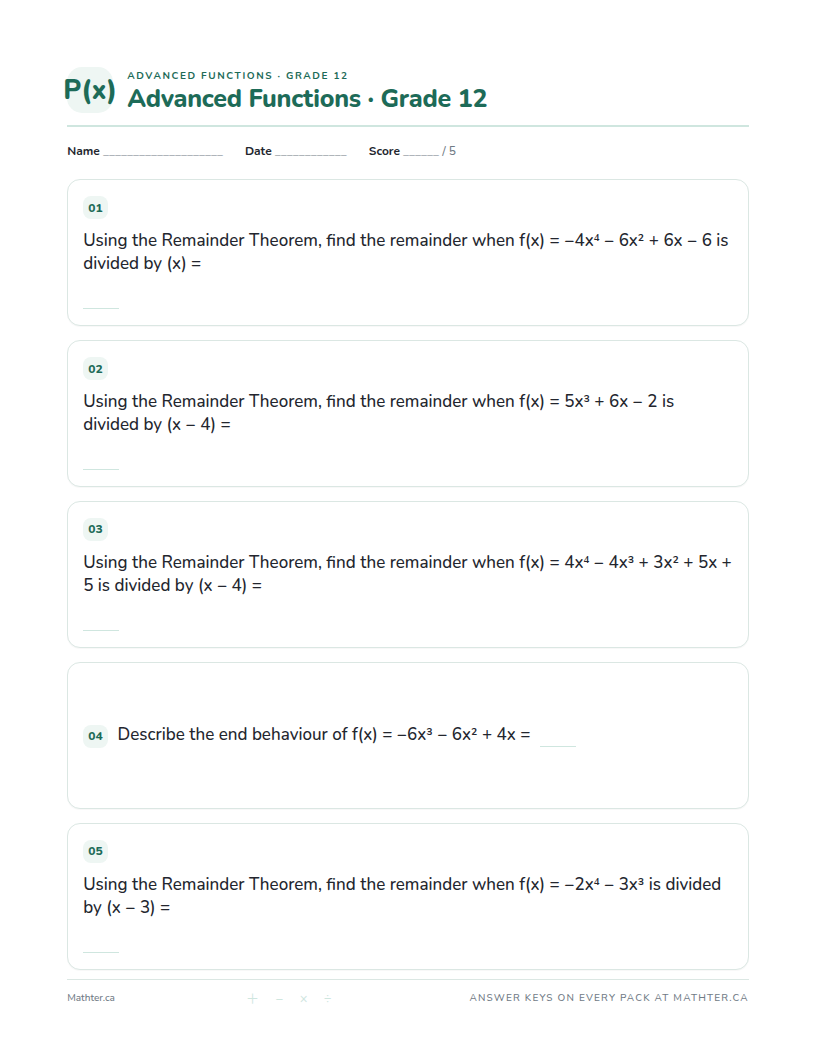
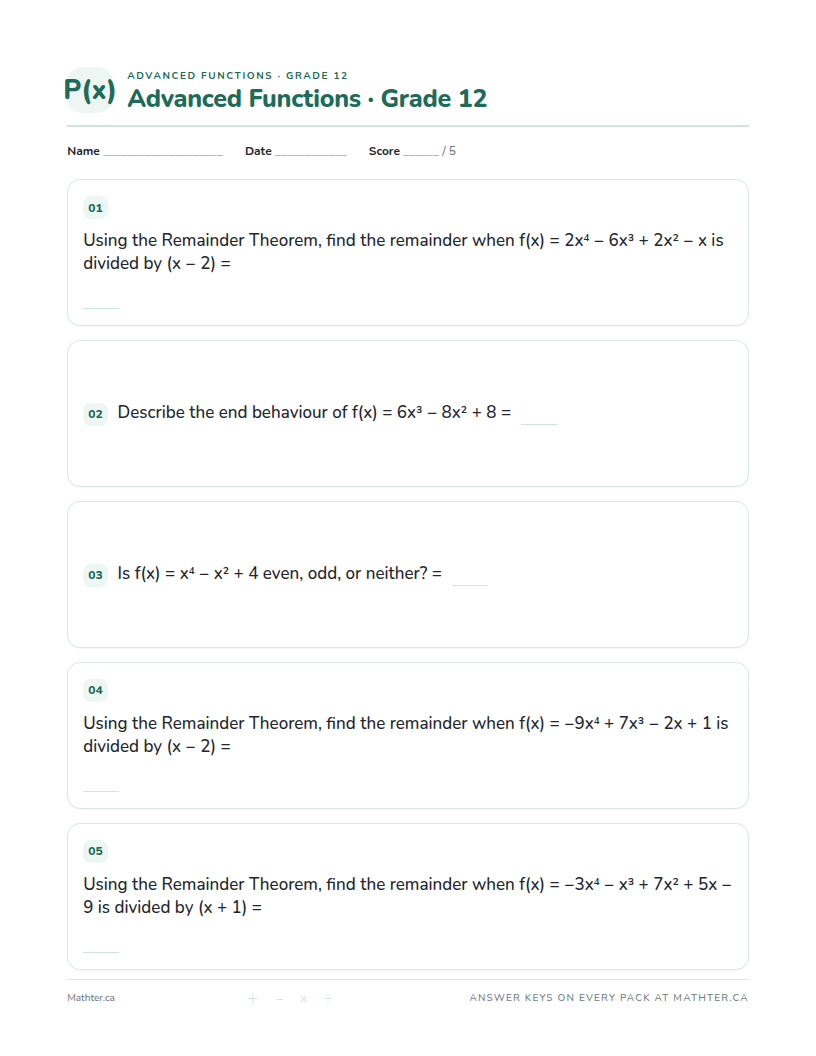
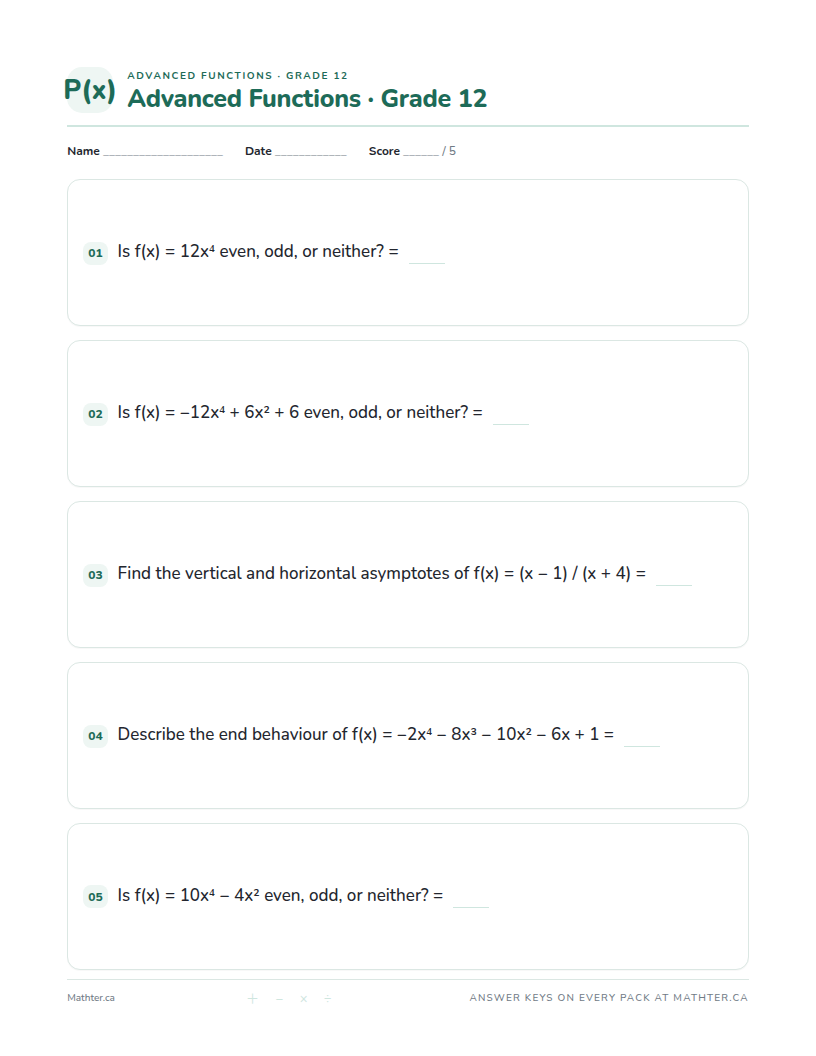
These three sheets are fixed, so you can bookmark or share them and get the same page back. Answer keys and fresh numbers come with a free account.
Why Grade 12 advanced functions practice matters
Reading a function's degree and leading coefficient to predict its shape, before ever graphing it, is the same habit of reasoning straight from the equation that calculus demands a year later.
Grade 12 is the only grade Mathter offers advanced functions worksheets for.
Want the full method, tips, and common mistakes? Read the Advanced Functions Worksheets guide.
Frequently asked questions
- What's on a Grade 12 advanced functions worksheet?
- Each pack has up to 12 questions per page with a matching answer key, tuned to Grade 12, with beginner, intermediate, and advanced options so a teacher, tutor, or parent can match the learner's level.
- What is the Remainder Theorem?
- When a polynomial f(x) is divided by (x − a), the remainder equals f(a): you don't need to do the division at all, just evaluate.
- What is the Factor Theorem?
- (x − a) is a factor of f(x) exactly when f(a) = 0: it's the Remainder Theorem's special case where the remainder is zero.
- How do you tell if a function is even, odd, or neither?
- Even if every term has an even degree (f(−x) = f(x), the graph is symmetric about the y-axis). Odd if every term has an odd degree (f(−x) = −f(x), symmetric about the origin). Neither if the degrees are mixed. This is a different question from end behaviour, which only looks at the leading term.
- How do you find a rational function's vertical asymptote?
- Set the denominator equal to 0 and solve: that's where the function is undefined and the graph shoots off to infinity.
- How do you find a rational function's horizontal asymptote?
- Compare the degrees of the numerator and denominator. If the denominator's degree is higher, the asymptote is y = 0. If they're equal, it's the ratio of the leading coefficients.
Make a Grade 12 advanced functions pack
Pick your options and print in seconds, with answer keys included.
Create free worksheetsFree to start · answer keys included · free accounts get 14 days of Standard · no card required.