Grade 12 · Calculus: Derivatives
Grade 12 Derivatives (Calculus) Worksheets
Printable Grade 12 derivatives (calculus) worksheets, sized to fit one page. Download a free sample below, or pick beginner, intermediate, or advanced and generate a fresh pack with answer keys in seconds. No AI, no wrong answers.
Create free worksheets →Free to start · answer keys included · free accounts get 14 days of Standard · no card required.
Grade 12 examples by level
- Beginnerd/dx (4x³ + 3x) =Answer12x² + 3
- Intermediated/dx () =Answer
- Advancedd/dx () =Answer
Real problems from the generator: always mathematically correct, and every pack is different.
Download a free Grade 12 derivatives (calculus) worksheet
One page, ready to print, no account needed. Pick a level:
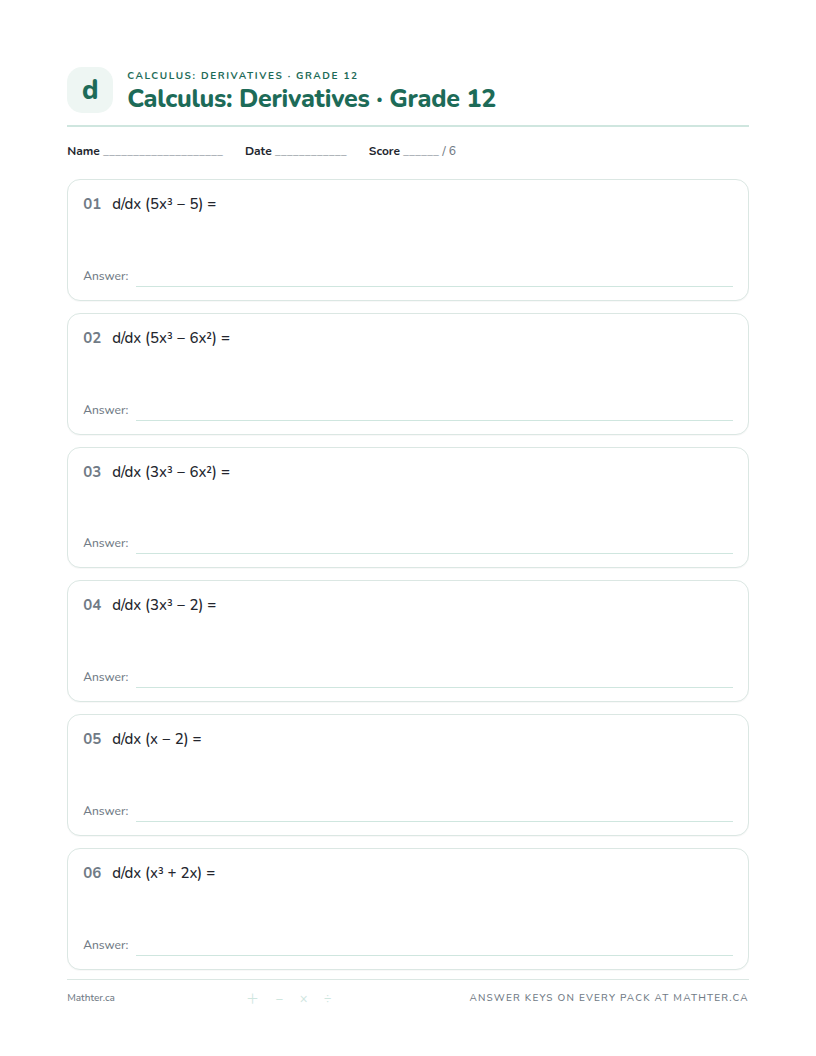
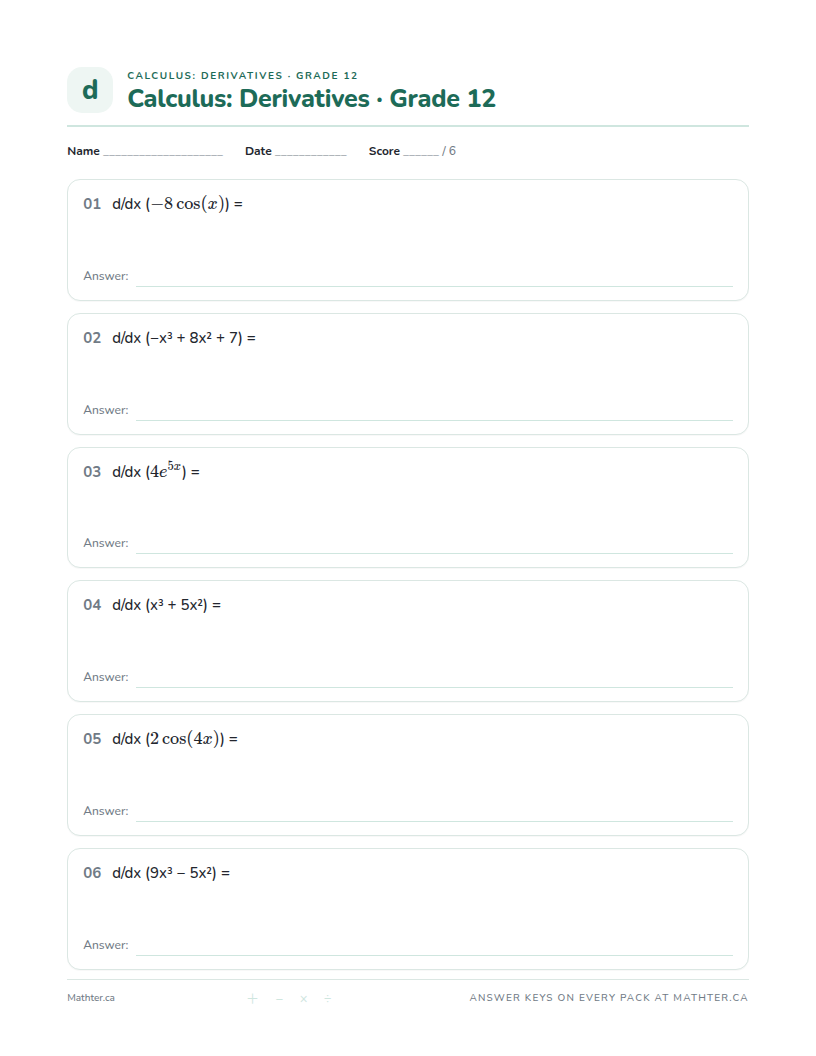
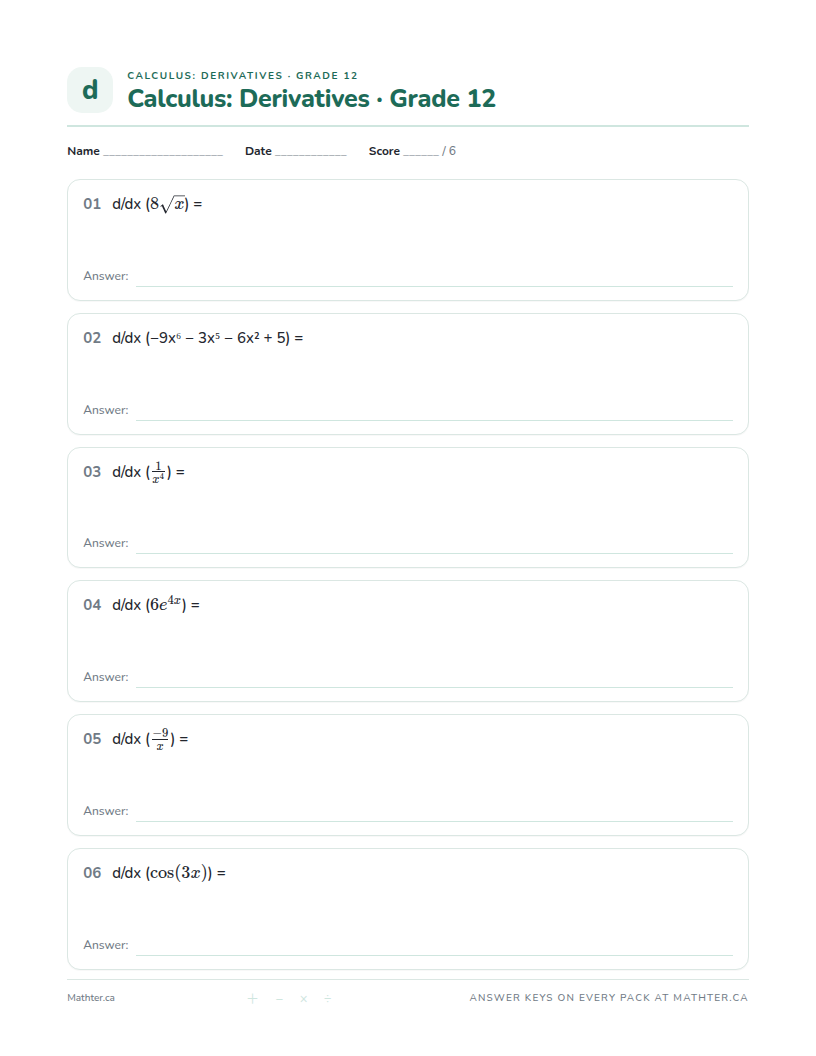
These three sheets are fixed, so you can bookmark or share them and get the same page back. Answer keys and fresh numbers come with a free account.
Why Grade 12 derivatives (calculus) practice matters
A derivative answers what no average ever can, exactly how fast something is changing at one instant, the way an engineer needs a rocket's precise velocity rather than its average over the flight.
Grade 12 is the only grade Mathter offers derivatives (calculus) worksheets for.
Want the full method, tips, and common mistakes? Read the Derivatives (Calculus) Worksheets guide.
Frequently asked questions
- What's on a Grade 12 derivatives (calculus) worksheet?
- Each pack has up to 12 questions per page with a matching answer key, tuned to Grade 12, with beginner, intermediate, and advanced options so a teacher, tutor, or parent can match the learner's level.
- What is the power rule?
- The derivative of a·xⁿ is a·n·xⁿ⁻¹, multiply by the exponent and lower the exponent by one.
- What is the derivative of a constant?
- Zero, a constant doesn't change, so its rate of change is 0.
- What is the derivative of sin(kx) and cos(kx)?
- d/dx[sin(kx)] = k·cos(kx), and d/dx[cos(kx)] = −k·sin(kx). The extra factor of k comes from the chain rule.
- What is the derivative of e^(kx)?
- d/dx[e^(kx)] = k·e^(kx), the exponential function is its own derivative, up to that chain-rule factor of k.
Make a Grade 12 derivatives (calculus) pack
Pick your options and print in seconds, with answer keys included.
Create free worksheetsFree to start · answer keys included · free accounts get 14 days of Standard · no card required.