Grade 6 · Probability
Grade 6 Probability Worksheets
Printable Grade 6 probability worksheets, sized to fit one page. Download a free sample below, or pick beginner, intermediate, or advanced and generate a fresh pack with answer keys in seconds. No AI, no wrong answers.
Create free worksheets →Free to start · answer keys included · free accounts get 14 days of Standard · no card required.
Grade 6 examples by level
- BeginnerA month of the year is chosen at random. P(a month with 30 days) =Answer1/3 (≈0.33, ≈33.3%)
- IntermediatePercent: Two dice are rolled and the numbers added. P(a sum of 7) =Answer≈16.7% (1/6, ≈0.17)
- AdvancedFraction: A letter is chosen at random from the word MATHEMATICS. P(a consonant) =Answer7/11 (≈0.64, ≈63.6%)
Real problems from the generator: always mathematically correct, and every pack is different.
Download a free Grade 6 probability worksheet
One page, ready to print, no account needed. Pick a level:
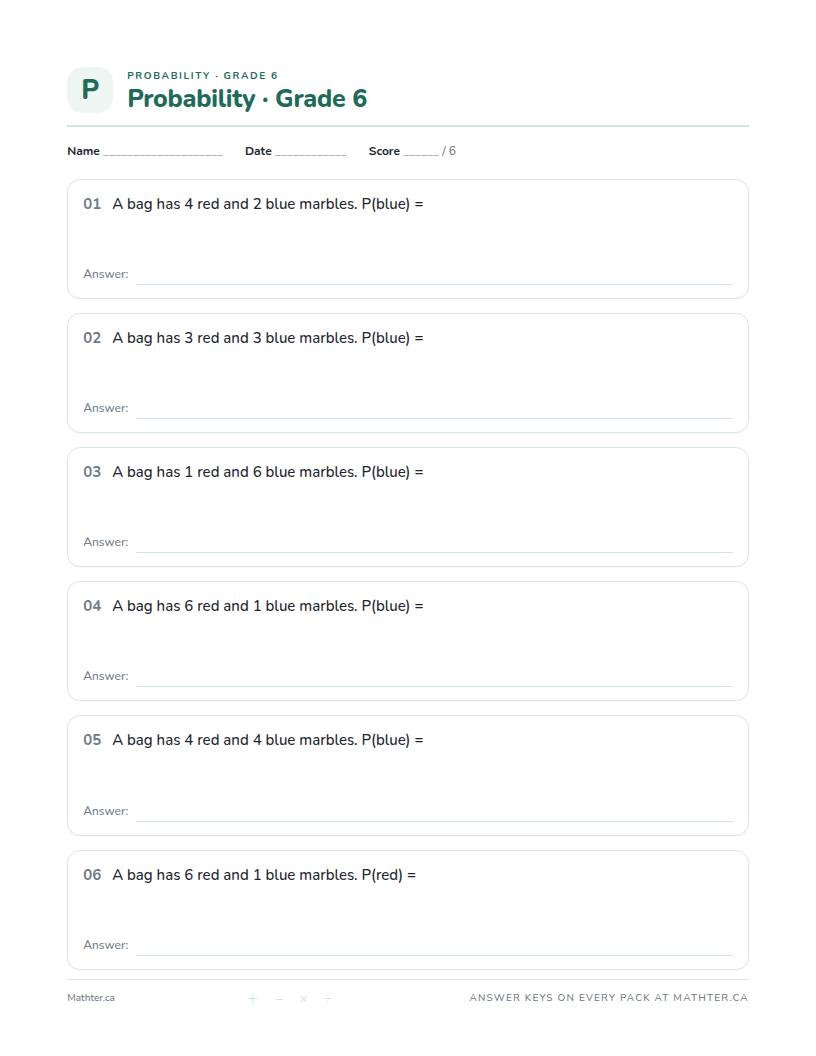
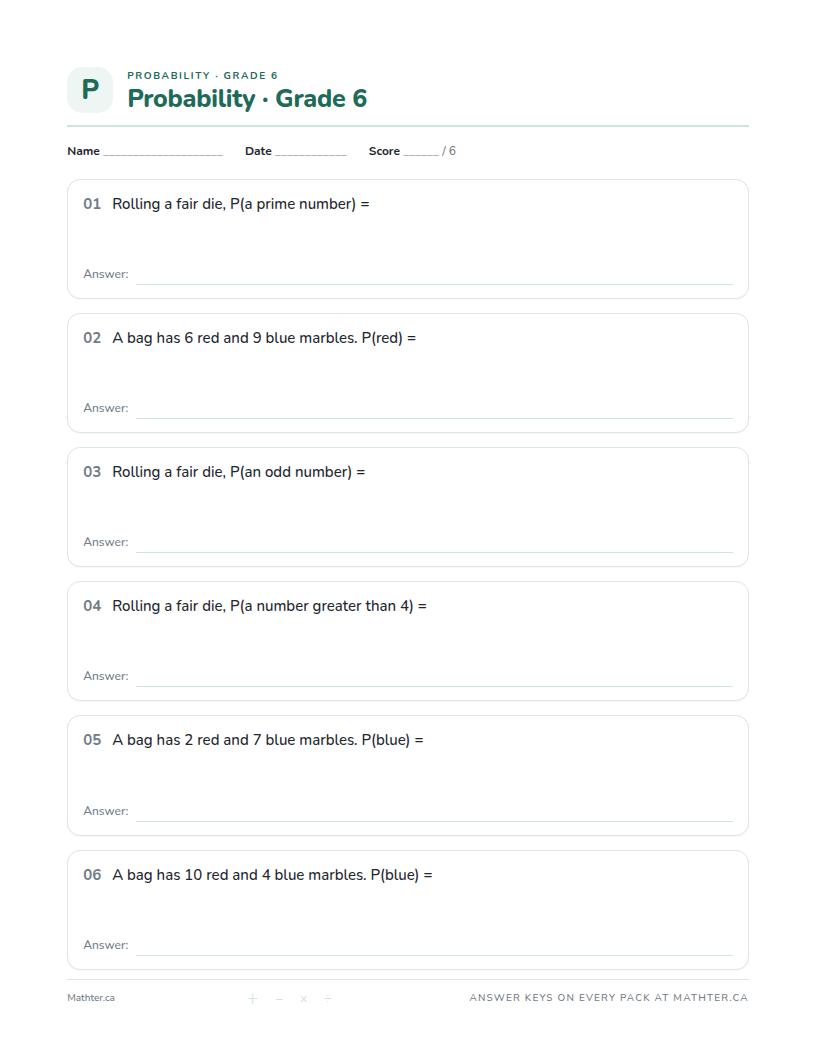
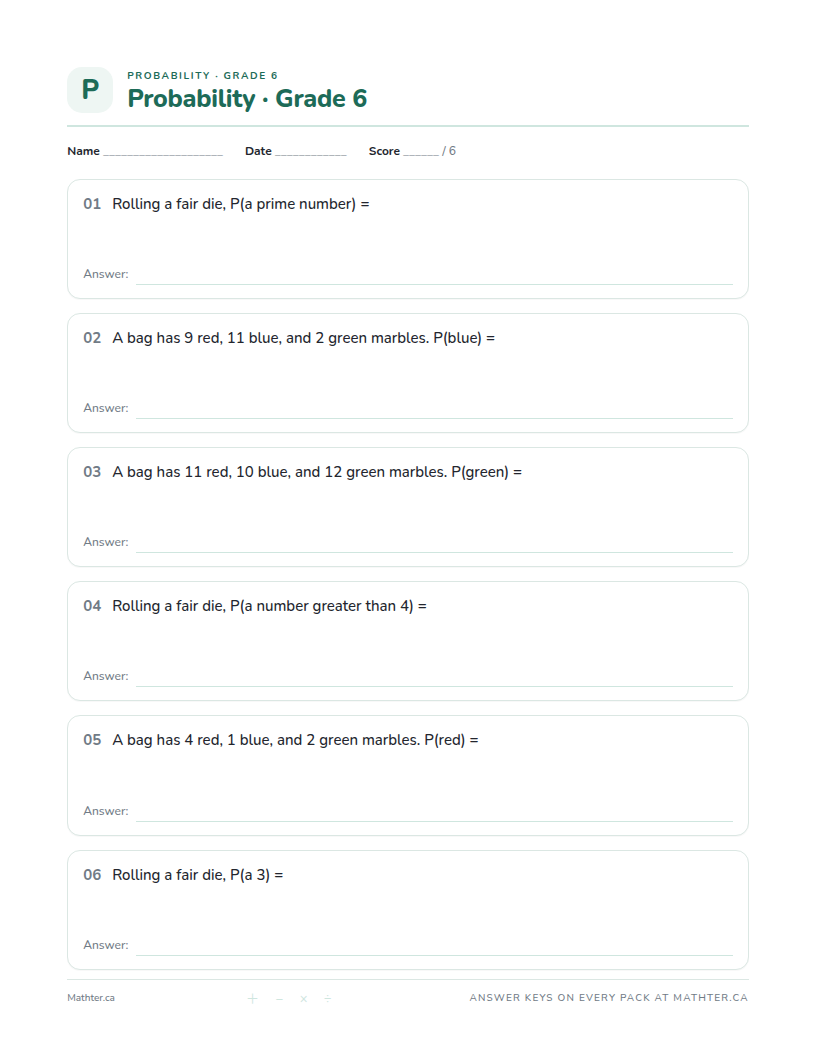
These three sheets are fixed, so you can bookmark or share them and get the same page back. Answer keys and fresh numbers come with a free account.
Why Grade 6 probability practice matters
What fraction of the outcomes actually go your way? That question, turned into a number between 0 and 1, is exactly what a 40 percent chance of rain means.
Grade 6 is where Mathter's probability worksheets first appear. Grade 7 picks up from here with more advanced problems.
Want the full method, tips, and common mistakes? Read the Probability Worksheets guide.
Frequently asked questions
- What's on a Grade 6 probability worksheet?
- Each pack has up to 12 questions per page with a matching answer key, tuned to Grade 6, with beginner, intermediate, and advanced options so a teacher, tutor, or parent can match the learner's level.
- How do you calculate probability?
- Divide the number of favourable outcomes by the total number of possible outcomes, then simplify. It can be written as a fraction, a decimal, or a percent.
- How do you find the probability of two independent events both happening?
- Multiply their individual probabilities: P(A and B) = P(A) × P(B).
- Can a probability be more than 1?
- No, probability ranges from 0 (impossible) to 1 (certain).
- How do you find P(A or B)?
- If A and B can't both happen (mutually exclusive), add their probabilities. If they can overlap, add them and then subtract P(A and B) so the overlap isn't counted twice.
- What is conditional probability?
- The probability of an event given that another event has already happened, e.g. the probability a second card is red, given the first one drawn (and not replaced) was also red.
Make a Grade 6 probability pack
Pick your options and print in seconds, with answer keys included.
Create free worksheetsFree to start · answer keys included · free accounts get 14 days of Standard · no card required.